When people hear the word urology, many reach for a simple rule: blast the stones, cut out the tumour. Surgery, it seems, is always the answer. In practice the hard part is rarely whether an operation can be done; it is whether it should be done, when it should be done, and whether there is a steadier plan that fits the patient better than the operating theatre does.
Many conditions appear to have a one-size-fits-all surgical solution. Behind that appearance lie diagnostic uncertainty, the trade-off of preserving organ function, the tolerance limits of older patients, and the question of lifelong quality of life. When a single department, or a single doctor, works alone, it is easy to slide into treating the disease rather than the person.
That is exactly why the urology department of Beijing United Family Hospital, led by Professor Zhu Gang, set up the Urologic Oncology Working Group of the Beijing United Family Comprehensive Cancer Center (BJIOC). The group holds a urologic oncology MDT — a multidisciplinary team meeting — at a fixed time every Thursday from 4 to 5 pm, bringing together urology, medical oncology, radiation oncology, radiology and pathology. The aim is to move past the limits of any single department and to build an individualised plan for every patient.
When the lesion is hard to classify: find the cause before choosing the treatment
A patient in their twenties was admitted through the emergency department with recurrent fever and severe pelvic pain. Imaging showed a 5 cm cystic and solid mass in the pelvis, with indistinct borders, invasion of the rectal wall and clearly aggressive morphology. Malignancy was strongly suspected. The conventional next step would have been aggressive surgical resection.
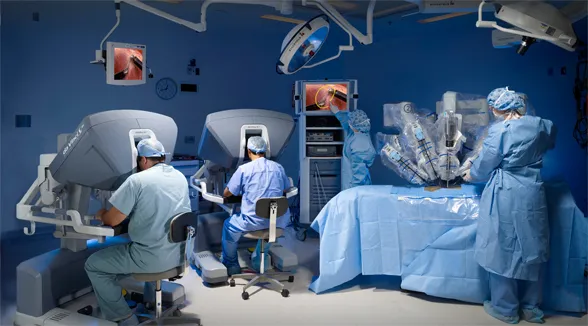
Before the operation, the BJIOC urologic oncology multidisciplinary meeting reviewed the case and agreed on a different strategy: precise exploration combined with real-time intraoperative frozen-section diagnosis. Rather than relying on a pre-operative guess, the team would let the pathologist's reading during the surgery set the direction of the operation.
During the procedure the urologist used the da Vinci robot to dissect the lesion precisely, working alongside a general surgeon to repair the rectal wall, preserving as much normal tissue as possible and reducing trauma. The frozen-section result ruled out malignancy, and the radical operation that had been planned was stopped in time. The patient was spared overtreatment.
The final diagnosis was idiopathic retroperitoneal fibrosis — a rare autoimmune condition that is easily misdiagnosed. It is seen mostly in middle-aged and older adults, and onset in young people is uncommon. Management focuses on immune modulation and long-term follow-up.
Once the diagnosis was clear, the team brought in rheumatology and immunology to complete the immune work-up, standardise medication, screen for hidden lesions elsewhere in the body and set up long-term follow-up to monitor the risk of recurrence. The patient's specialist treatment is progressing well, recovery has been good, and there have been no complications.
When a tumour reaches a neighbouring organ: save the organ, and protect the life
Another patient had sigmoid colon cancer that had invaded the bladder, reaching the trigone — the area that controls urination. The conventional route would be to recommend removal of the whole bladder in order to lower the risk of local recurrence. But that operation clears the disease at the price of permanently losing normal urinary function.
The multidisciplinary team analysed the case in full. The patient carried a KRAS mutation, which limits the choice of targeted drugs; chemotherapy could only keep the disease stable; and treatment would still be needed long term after surgery. At the same time the patient was relatively young and had high expectations for quality of life. A permanent urostomy bag, and the loss of the ability to urinate voluntarily, would have an irreversible effect on daily life, social life and psychological wellbeing.
Weighing the multidisciplinary opinions, the team settled on an individualised strategy: preserve the organ and preserve quality of life first.
During surgery, frozen section was used to judge the margin status in real time, and no preventive total cystectomy was performed without an indication. If the margins had been positive, or residual disease suspected, the team would have discussed the situation with the patient, based on what was found during the operation, and agreed together on a suitable urinary reconstruction.
Restraint in medicine, empathy at heart
The BJIOC urologic oncology working group has made the MDT meeting a standing part of how it works. It is not only several specialties sitting in the same room: it is a shift in approach. The goal is not the most idealised plan on paper, but the plan that fits the patient's condition and needs.
The working group will continue to rely on the MDT platform — rigorous in unravelling difficult cases, warm in delivering care, taking every concern seriously and listening to every hope.
To arrange a urologic oncology multidisciplinary consultation, you are welcome to visit the urology outpatient clinic at Beijing United Family Hospital.
About the department
The urology department of Beijing United Family Hospital is staffed by a team with extensive clinical experience and overseas medical backgrounds. Under the leadership of Professor Zhu Gang — a specialist in urologic oncology and minimally invasive surgery, and director of the department — it follows international guidelines and standards, keeps exploring and studying new techniques, and provides urologic diagnosis, treatment and surgical services to patients from China and around the world.
The department offers, among others, the following services:
- Urologic tumours
- Minimally invasive surgery
- Urinary stones
- Voiding dysfunction and urinary incontinence
- Urogenital trauma
- Infectious diseases of the urinary and male reproductive systems
- Andrology and men's health
- Congenital urologic conditions
To reach our surgical assistant, scan the hospital's WeChat QR code at reception.
About the source
BJIOC Urologic Oncology Working Group — Beijing United Family Hospital
Source: the Beijing United Family Hospital public-education article "Treating Disease Is Never Just Surgery", written by Liu Xiaojing for BJIOC. Adapted for international readers by MedTourChina.
Facing a complex urologic cancer diagnosis in China? Our international team can help you arrange a multidisciplinary review and reach the right specialists. We reply within 24 hours.
Speak with our international team · See the Beijing campuses and clinics