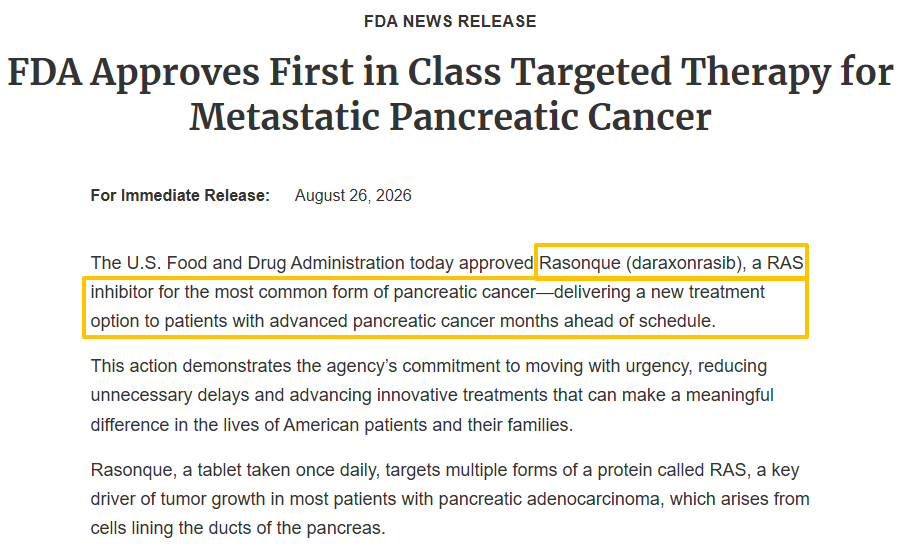
On 26 August 2026 the United States Food and Drug Administration approved daraxonrasib, marketed as Rasonque, for the most common form of pancreatic cancer. The decision arrived roughly six and a half months ahead of the target action date, and it makes daraxonrasib the first approved targeted therapy for the disease. For adults with advanced pancreatic adenocarcinoma, it delivers a new treatment option sooner than expected.
The news matters beyond the United States. Daraxonrasib has not yet been approved for marketing in mainland China, but Hong Kong’s accelerated registration mechanism and its Named Patient Access programme give eligible patients a compliant route to a medicine that is already in clinical use internationally.
Why pancreatic cancer is still called the king of cancers
Pancreatic adenocarcinoma accounts for a modest share of all cancer diagnoses, yet it ranks among the leading causes of cancer death. The reason lies in the arithmetic of late detection. Fewer than one in twenty patients in China is diagnosed at an early stage, the disease progresses quickly, and treatment options have historically been limited.
About 60% of patients already have metastatic disease by the time they are first seen. Five-year survival in China hovers between 7.2% and 9%. In the United States, the American Cancer Society’s 2026 projections put overall five-year relative survival at 13%, and for disease that has already spread to distant organs that figure falls to just 3%.
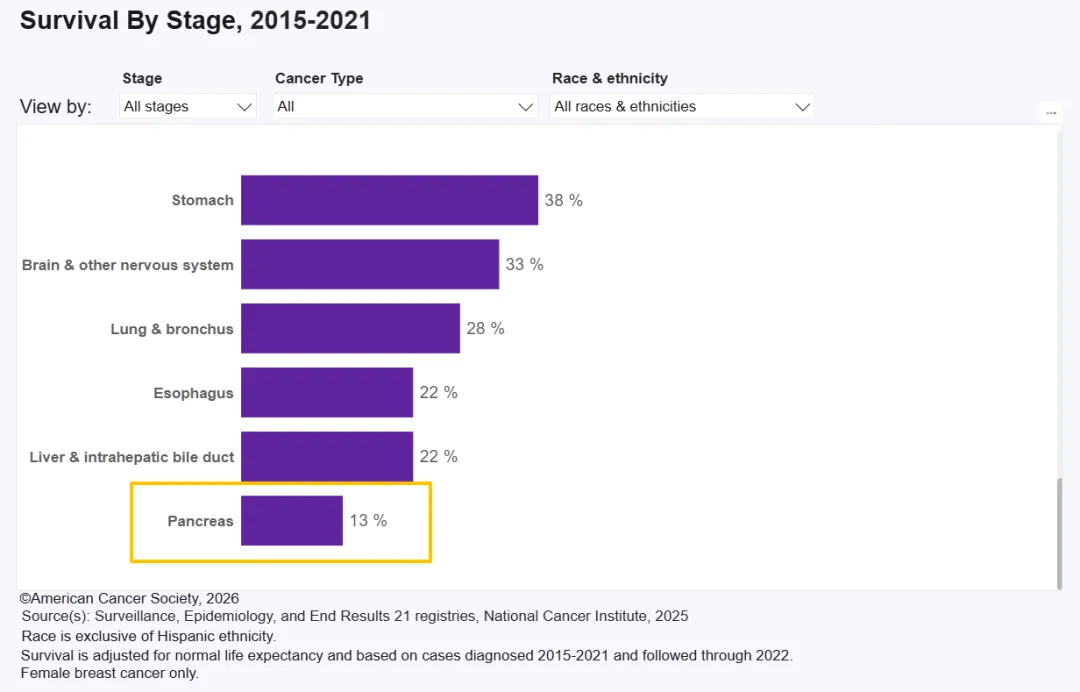
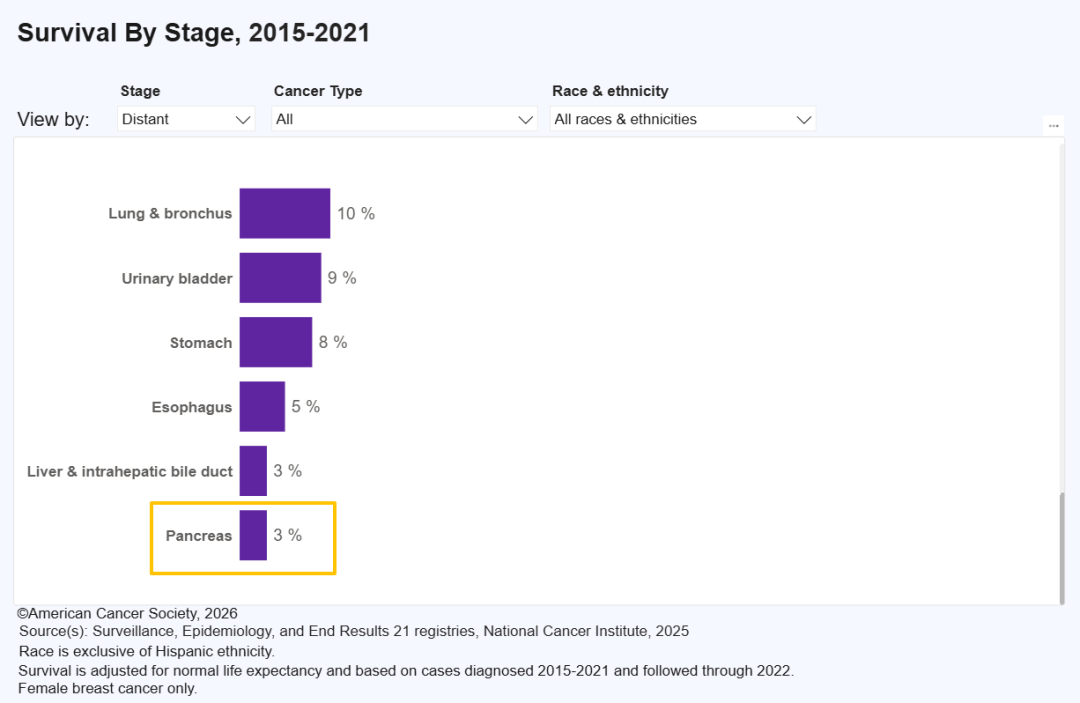
At the population level the picture is equally stark. The American Cancer Society projects about 67,530 new pancreatic cancer cases in the United States in 2026, and about 52,740 deaths from the disease. That breaks down into roughly 35,190 men and 32,340 women diagnosed, and 27,230 men and 25,510 women who will die of it. The average lifetime risk is about 1 in 56 for men and 1 in 60 for women.
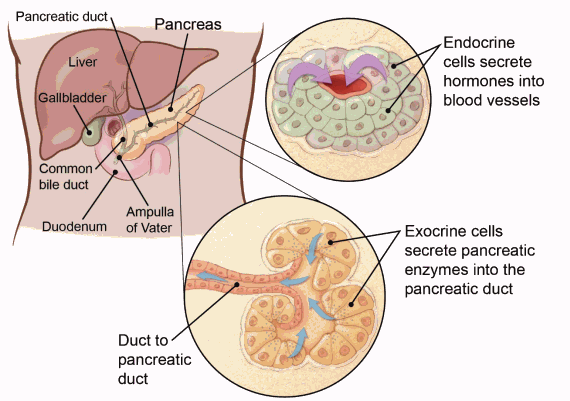
Within pancreatic malignancies broadly defined, pancreatic ductal adenocarcinoma — PDAC — accounts for more than 90% of cases and is the central challenge in clinical practice. It arises from the cells lining the ducts of the pancreas, which is why the anatomy of the organ matters to how the disease behaves.
RAS gene mutations drive the development of most pancreatic adenocarcinomas. The RAS family has three principal isoforms — KRAS, NRAS and HRAS. Because the surface of the RAS protein lacks a conventional drug-binding pocket, it was treated for decades as the classic undruggable target. What changed is that daraxonrasib reaches the protein in its active state rather than trying to block the pocket, which is precisely what made an approved drug possible.
The story starts in 1982, the year Nature called the Year of the Oncogene. Three independent teams — Robert Weinberg’s group at MIT, Mike Wigler’s at Cold Spring Harbor and Mariano Barbacid’s at the National Cancer Institute — published work showing that a minute change in a single gene was enough to drive a normal cell to become cancerous, carrying cancer research into the molecular era.
The transforming gene taken from a bladder tumour cell line proved to be a transforming allele of HRAS. HRAS had first been isolated from rat sarcoma in 1964 and classified at the time as a retroviral oncogene. In December of that year Barbacid’s team identified five oncogenes, HRAS and KRAS among them, from human solid tumours. KRAS has been on the stage ever since.
A standing ovation at ASCO, then approval months early
On 31 May 2026 the primary results of RASolute 302, the pivotal phase III study of daraxonrasib, also known as RMC-6236, were presented in a plenary session at the American Society of Clinical Oncology Annual Meeting in Chicago. The audience rose to its feet, and the applause ran on well past the end of the presentation. The field has come to regard the result as the most consequential advance in pancreatic cancer treatment in more than half a century. ASCO’s chief medical officer, Julie Gralow, spoke positively about its clinical significance.
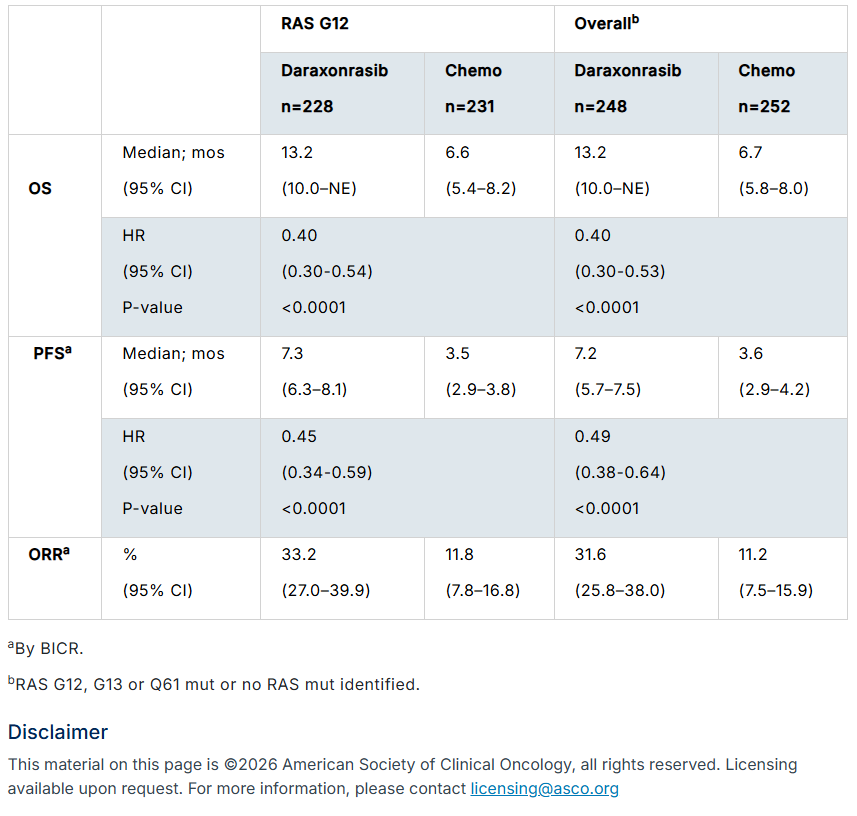
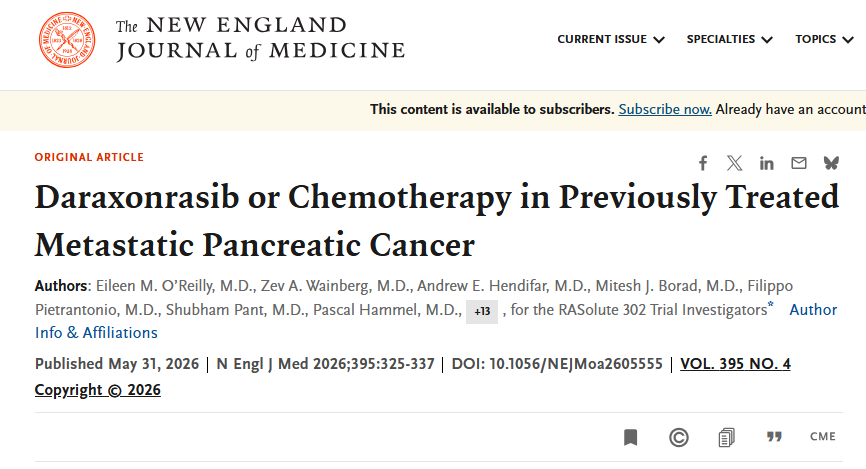
RASolute 302 is a global, multicentre, randomised controlled phase III study, and it met its endpoints at the interim analysis with a statistically significant result. Median overall survival reached 13.2 months in patients treated with daraxonrasib, against 6.7 months in the chemotherapy group — roughly a doubling — with the risk of death reduced by 60%. The findings were published at the same time in the New England Journal of Medicine.
The study enrolled 500 patients with metastatic pancreatic adenocarcinoma and randomised them 1:1 to oral daraxonrasib or to standard chemotherapy chosen by the investigator. In the intention-to-treat population, the results were:
- median overall survival of 13.2 months versus 6.7 months, with the risk of death reduced by 60%
- median progression-free survival of 7.2 months versus 3.6 months
- an objective response rate of 30% versus 11%
One caution is worth stating plainly. These are group-level results from a clinical trial population. They do not mean that every individual patient will obtain the same degree of survival benefit.
Then came the regulatory step. On 26 August 2026, acting on the strength of RASolute 302, the FDA approved daraxonrasib for marketing about six and a half months ahead of schedule. The approval widens the treatments available to patients and gives oncology teams a reference point for the next generation of RAS-directed strategies.
Who the approval covers, and how the drug works
Daraxonrasib is approved for adults with metastatic pancreatic adenocarcinoma who meet at least one of two conditions. They have already received at least one line of systemic therapy, or they have been assessed as unsuitable for multi-agent combination chemotherapy.
One detail is unusual and worth noting. This approval does not require prior companion diagnostic testing for RAS. Patients may be eligible whether or not a RAS mutation is detected in their tumour. The recommended regimen is a single oral dose once a day, continued until the disease progresses or unacceptable toxicity appears.
Mechanistically, daraxonrasib is a RAS(ON) multi-selective inhibitor. Once inside the body it binds cyclophilin A to form a ternary complex that targets RAS in its active state and interrupts the downstream signalling that drives tumour proliferation, which is how it restrains tumour growth. Because the mechanism addresses the active form of the protein rather than a single mutation site, it covers a range of common RAS variants instead of being confined to one.
On safety, the adverse reactions seen in trials were mostly manageable, but several require close monitoring: skin and soft-tissue toxicity, stomatitis, diarrhoea, gastrointestinal perforation, interstitial lung disease and pneumonitis, and embryo-foetal toxicity, meaning a risk of harm to the foetus if the drug is used during pregnancy.
Clinical use still depends on specialist judgement
Trial data describe group-level statistics, and individual benefit varies. Any innovative medicine must be assessed by a clinical oncologist, who confirms that the patient’s physical condition and disease status meet the indication and then builds a comprehensive plan around the individual rather than the average.
An access route for patients in China
Daraxonrasib has not yet received marketing approval in mainland China. In 2023 the Hong Kong government further streamlined its drug approval mechanism by introducing the 1+ accelerated registration pathway. The policy allows new medicines already approved by recognised international regulators such as the FDA to be registered in Hong Kong more quickly, so that some patients with cancer can reach the newest internationally developed medicines earlier.
For patients with a clinical need, treatment can be requested through Hong Kong’s Named Patient Access programme, commonly known as the new drug green channel, once a doctor has assessed them in person.
Name Patient Access Program: patients may use this route where the innovative medicine they need is not yet registered in Hong Kong but is already marketed in Europe, the United States or mainland China, and where a Hong Kong doctor, usually a clinical or medical oncologist, has diagnosed and assessed them and confirmed that the medicine is appropriate or necessary.
The Integrated Oncology Centres of New Frontier Medical operate in Beijing, Shanghai, Guangzhou, Shenzhen and Hong Kong, China, built around a full-cycle pathway that runs from screening and diagnosis through treatment, follow-up, rehabilitation and supportive care. The centres follow cancer prevention, treatment and rehabilitation education closely, and will continue to review and share clinical research and treatment advances across tumour types so that patients and the public receive timely and professional information.
What matters about an innovative medicine is not only the clinical data behind it. It is whether the advance reaches patients through services that are professional, well governed and delivered with care. United Family Healthcare follows international developments closely and builds individualised treatment strategies around the differences between patients.
About the source
Source: the United Family Healthcare public-education article on the early FDA approval of daraxonrasib for metastatic pancreatic cancer. Adapted for international readers by MedTourChina.
Important information
This article is intended for disease and drug education only and does not constitute individualised diagnostic or treatment advice for any patient. For indications, dosage, adverse reactions and precautions, always refer to the latest version of the product label approved by the national drug regulatory authority.
References
- US Food and Drug Administration. FDA Approves First in Class Targeted Therapy for Metastatic Pancreatic Cancer. News release, 26 August 2026.
- China Anti-Cancer Association. China Malignant Tumour Discipline Development Report, 2022.
- American Cancer Society. Cancer Statistics Center: 2026 estimated new cases and deaths.
- NCCN Guidelines for Patients: Pancreatic Cancer.
- Reddy E, Reynolds R, Santos E, et al. A point mutation is responsible for the acquisition of transforming properties by the T24 human bladder carcinoma oncogene. Nature. 1982;300:149-152.
- Wolpin BM, et al. Daraxonrasib versus chemotherapy in previously treated metastatic pancreatic adenocarcinoma, RASolute 302: primary results of a randomised, open-label, phase 3 trial. 2026 ASCO Annual Meeting. Abstract LBA5.
- Wolpin BM, et al. Daraxonrasib in previously treated metastatic pancreatic cancer, RASolute 302. N Engl J Med. 2026.
- Hong Kong Drug Office. The 1+ mechanism for registration of pharmaceutical products containing new chemical or biological entities.
Facing a pancreatic cancer diagnosis in China? Our international team can help you arrange a specialist review and explore access to internationally approved medicines. We reply within 24 hours.
Speak with our international team · See our hospital locations