
A new treatment option has arrived for two groups of patients who often find themselves running short of choices. Under the Hong Kong and Macao Medicine and Medical Device Connect scheme — the policy that lets designated hospitals in the Greater Bay Area use medicines and devices already approved in Hong Kong, China or Macao, China before they reach the mainland market — cabozantinib is now available at Guangzhou United Family Hospital and Shenzhen New Frontier United Family Hospital. The drug, sold under the brand name Cabometyx, extends the options open to adults with advanced renal cell carcinoma and advanced hepatocellular carcinoma.
Cabozantinib is not a new molecule. What is new is the route by which it reaches patients here, and the fact that it can now be prescribed inside designated mainland institutions rather than sought across the border. This article looks at what the drug does, which patients it is intended for, and how an oral targeted therapy of this kind is managed in practice.
Cabozantinib: the multi-target drug among targeted therapies
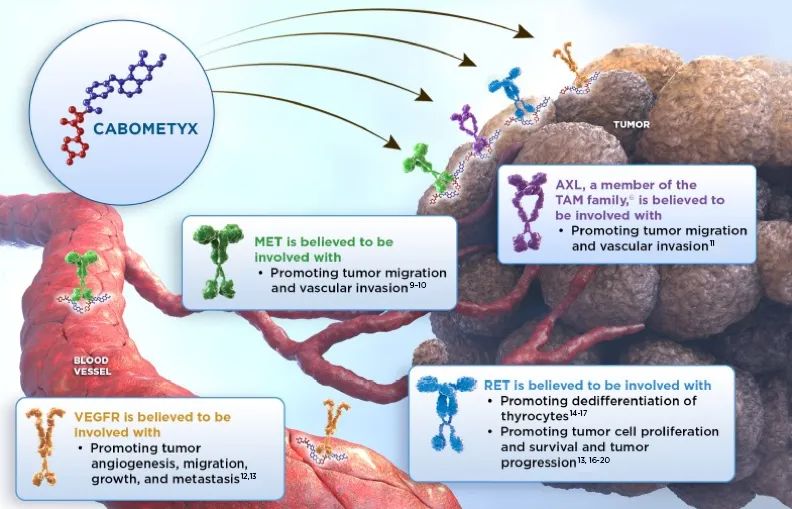
Cabozantinib is an oral small-molecule tyrosine kinase inhibitor. Unlike drugs designed against a single target, it acts on several signalling pathways involved in tumour growth at the same time — c-MET, AXL, VEGFR and RET among them. Those pathways are linked not only to the growth of cancer cells but also to the formation of new tumour blood vessels, to invasion, to metastasis and to drug resistance. In plain terms, cabozantinib can intervene on several fronts at once:
- it inhibits tumour growth
- it inhibits the formation of tumour blood vessels
- it interferes with signalling associated with drug resistance
- it inhibits tumour invasion and metastasis
Cabozantinib is supported by large phase III studies in both renal cell carcinoma and hepatocellular carcinoma, which is an unusual position for a single agent to occupy. The evidence below comes from three of those trials.
Cabozantinib alone: a further option after VEGF-targeted treatment
The METEOR study enrolled patients with advanced renal cell carcinoma who had previously received VEGF-targeted therapy. Compared with everolimus, the cabozantinib group showed:
- median progression-free survival of 7.4 months versus 3.8 months
- median overall survival of 21.4 months versus 16.5 months
- an objective response rate of 17% versus 3%
The results indicate that for some patients with advanced renal cell carcinoma who have already had VEGF-targeted treatment, cabozantinib can further delay progression and improve survival outcomes.
Cabozantinib with nivolumab: a first-line option for advanced kidney cancer
In the long-term follow-up of the CheckMate 9ER study, cabozantinib combined with nivolumab showed sustained disease control and survival benefit compared with sunitinib:
- median progression-free survival: 16.4 months versus 8.3 months
- median overall survival: 46.5 months versus 35.5 months
- risk of progression or death reduced by about 42% (HR 0.58)
These figures compare the cabozantinib-plus-nivolumab group with the sunitinib group. The study suggests that for eligible patients with advanced renal cell carcinoma, a combination of targeted therapy and immunotherapy can be considered as a first-line option.
Hepatocellular carcinoma: an option after sorafenib
The CELESTIAL study enrolled patients with advanced hepatocellular carcinoma who had previously received sorafenib. Compared with placebo, the cabozantinib group showed:
- median progression-free survival of 5.2 months versus 1.9 months
- risk of progression or death reduced by about 56%
- median overall survival of 10.2 months versus 8.0 months
Which patients is cabozantinib for?
The cabozantinib introduced through the scheme covers two main groups of patients: advanced renal cell carcinoma and hepatocellular carcinoma.
Advanced renal cell carcinoma
- As a single agent, for first-line treatment of adults with intermediate-risk or poor-risk advanced renal cell carcinoma, and for adults who have previously received vascular endothelial growth factor (VEGF)-targeted therapy.
- In combination with nivolumab, for first-line treatment of adults with advanced renal cell carcinoma.
Hepatocellular carcinoma
- As a single agent, for adults with hepatocellular carcinoma who have previously received sorafenib.
One point deserves emphasis. A drug arriving at the hospital does not mean that every patient with kidney or liver cancer is a suitable candidate for it. Suitability has to be assessed by the treating physician, taking into account the type of tumour, previous treatment, how the disease has progressed, liver and kidney function, and the patient’s overall physical condition.
An oral targeted drug still needs professional management
Cabozantinib is an oral prescription medicine, but oral does not mean it can be taken, or its dose adjusted, independently. Treatment needs continuous monitoring by the medical team, with the plan adjusted promptly according to how well the patient tolerates the drug. The problems most often watched for include:
- diarrhoea
- hand-foot syndrome
- high blood pressure
- fatigue and loss of appetite
- nausea and vomiting
- changes in liver function or in electrolyte levels
- protein in the urine
Adverse reactions and their likelihood can differ between cancer types. Many of them appear early in treatment, which makes the first eight weeks a period of particularly close monitoring. Doctors will arrange blood pressure checks, blood tests, liver and kidney function tests, electrolytes and urine protein monitoring as the situation requires, and will provide supportive treatment, pause the drug or adjust the dose when necessary.
Patients should not stop the drug or reduce the dose on their own, and should not combine it with other medicines or supplements without telling their treating team.
Closing the gap between patients and the international frontier
In the past, a patient who needed an international medicine not yet approved in mainland China might have had to look across the border for information, or for treatment. Under the Hong Kong and Macao Medicine and Medical Device Connect scheme, United Family Healthcare can introduce clinically needed medicines and devices in line with the rules and bring them into use early, compressing the delay between mainland patients and the international treatment frontier.
For eligible patients, the whole pathway can be completed inside a designated institution: oncology specialist assessment, review of the conditions for use, an individualised plan, and then monitoring of adverse reactions, dose adjustment and follow-up. This is not simply a matter of bringing a drug in. It is about letting patients receive a new treatment safely, and to standard, under the care of a professional medical team.
Guangzhou United Family Hospital and Shenzhen New Frontier United Family Hospital are both designated institutions under the scheme in the Guangdong–Hong Kong–Macao Greater Bay Area. Both will continue to draw on international medical resources and multidisciplinary collaboration to bring more innovative medicines and devices to residents of the Greater Bay Area.
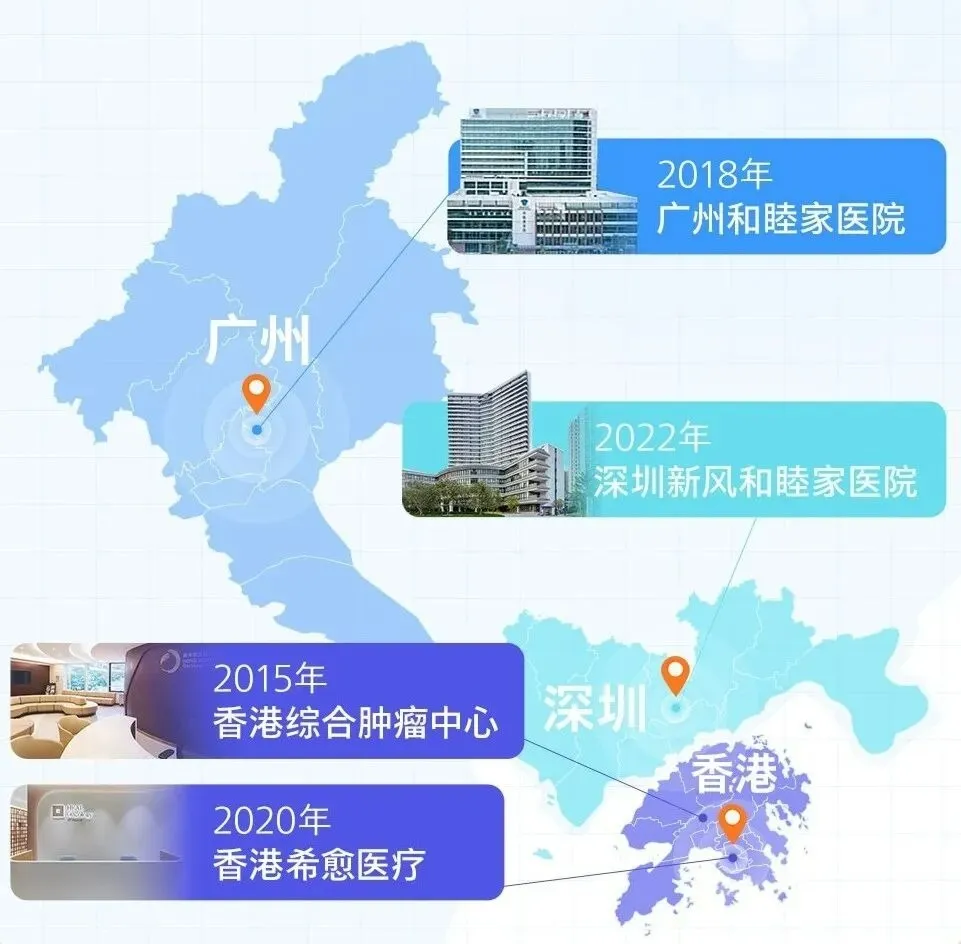
New Frontier Medical also operates Integrated Oncology Centres in Beijing, Shanghai, Guangzhou, Shenzhen and Hong Kong, China, built around a full-cycle pathway that runs from screening and diagnosis through treatment, follow-up and rehabilitation to supportive care. The centres put survival benefit, quality of life and treatment experience first, follow advances presented at international oncology congresses including ASCO, ESMO and WCLC, and offer a broad range of options covering targeted therapy, immunotherapy, antibody-drug conjugates and innovative drugs developed in China.
About the authors
Shi Ying is chief pharmacist of New Frontier Medical Group, chief pharmacist of New Frontier Medical in the Greater Bay Area, director of the Hong Kong Integrated Oncology Centre, director of pharmacy at HEAL Medical in Hong Kong, China, and director of pharmacy at Shenzhen New Frontier United Family Hospital.
Ma Dong is an oncologist in the medical oncology department at Shenzhen New Frontier United Family Hospital, and a chief physician and professor.
About the source
Source: the United Family Healthcare public-education article on cabozantinib arriving at United Family Healthcare through the Hong Kong and Macao Medicine and Medical Device Connect scheme. Adapted for international readers by MedTourChina.
Important information
This article is intended for disease and drug education only and does not constitute individualised diagnostic or treatment advice for any patient. For indications, dosage, adverse reactions and precautions, always refer to the latest version of the product label approved by the national drug regulatory authority.
References
- Choueiri TK, Escudier B, Powles T, et al. Cabozantinib versus Everolimus in Advanced Renal-Cell Carcinoma. N Engl J Med. 2015;373(19):1814-1823. doi: 10.1056/NEJMoa1510016.
- Choueiri TK, Powles T, Burotto M, et al. Nivolumab plus Cabozantinib versus Sunitinib for Advanced Renal-Cell Carcinoma. N Engl J Med. 2021;384(9):829-841. doi: 10.1056/NEJMoa2026982.
- Abou-Alfa GK, Meyer T, Cheng AL, et al. Cabozantinib in Patients with Advanced and Progressing Hepatocellular Carcinoma. N Engl J Med. 2018;379(1):54-63. doi: 10.1056/NEJMoa1717002.
- Cabozantinib (Cabometyx) summary of product characteristics and mechanism-of-action materials, as cited in the source article.
Facing an advanced liver or kidney cancer diagnosis in China? Our international team can help you arrange a specialist review and reach the right oncology team. We reply within 24 hours.
Speak with our international team · See our hospital locations