When a driver mutation is found in a lung cancer, the first question a patient asks is a simple one: is there a drug that targets it? For HER2-mutant non-small cell lung cancer, the honest answer has until recently been an unsatisfying one. Targeted options existed mainly for patients who had already been through systemic treatment. First-line care still followed the playbook used for tumours with no actionable driver at all: platinum-based chemotherapy, immunotherapy, or a combination of the two.
The approval of zongertinib for previously untreated HER2-mutant advanced non-small cell lung cancer changes that starting point. In China it became the first targeted therapy approved for the first-line treatment of HER2-mutant lung cancer, and guideline updates on both sides of the Pacific have followed. A HER2-selective targeted drug has moved from the later lines of treatment to the front.
HER2-mutant lung cancer: a small subgroup with a difficult course
According to GLOBOCAN 2022 data published by the International Agency for Research on Cancer, there are roughly 2.48 million new cases of lung cancer worldwide each year. Non-small cell lung cancer accounts for about 85% of them, which works out at some 2.1 million new cases a year.
Non-small cell lung cancer is not a single disease. As molecular testing has developed, more and more of the gene changes that drive tumour growth have been identified, and HER2 (ERBB2) mutation is one of them. The evidence shows that:
- About 2% to 4% of non-small cell lung cancers are driven by a HER2 mutation.
- HER2 mutations are found mostly in lung adenocarcinoma, and are relatively common in women and in patients with no history of smoking.
- The mutations usually sit in the tyrosine kinase domain of HER2, and exon 20 insertions are the most common type.
- HER2-mutant tumours tend to be more aggressive, and some patients also carry a higher risk of brain metastases.
Once an activating mutation occurs in the HER2 gene, the kinase activity of the HER2 protein can stay switched on, continuously passing growth and survival signals to the tumour cell and driving its proliferation, invasion and spread.
The practical problem was never the biology alone. It was the toolbox. Because HER2 mutations are uncommon, and because earlier HER2-directed drugs were held back by toxicity and by the way they engaged the target, first-line treatment for these patients was usually decided as though no driver had been found at all. For this particular driver, a precision drug that could be used directly in the first line was missing for a long time. The new zongertinib indication fills that gap.
What is zongertinib?
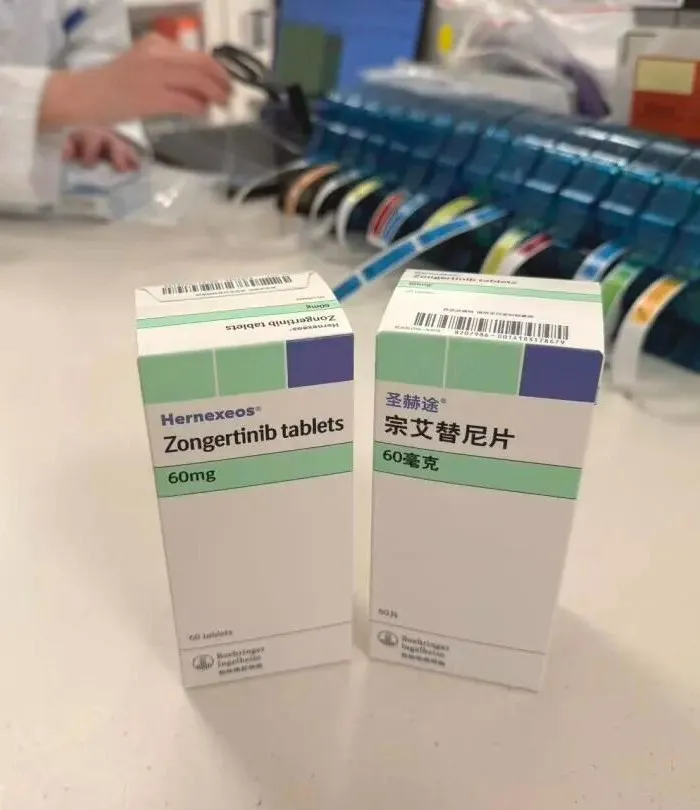
Zongertinib is an imported oral small-molecule targeted drug developed by Boehringer Ingelheim. It is a selective, irreversible inhibitor of the HER2 tyrosine kinase.
- Generic name: zongertinib tablets
- Brand name: Hernexeos
- Developer: Boehringer Ingelheim
- Drug class: selective irreversible HER2 tyrosine kinase inhibitor
- Route of administration: oral
How zongertinib works
After entering the tumour cell, zongertinib selectively binds the tyrosine kinase domain inside the HER2 protein and forms a covalent bond at a specific site, which inhibits HER2 kinase activity irreversibly. With HER2 signalling suppressed, the downstream pathways that drive tumour cell proliferation and survival weaken, and the growth of HER2-mutation-driven tumour cells is held back.
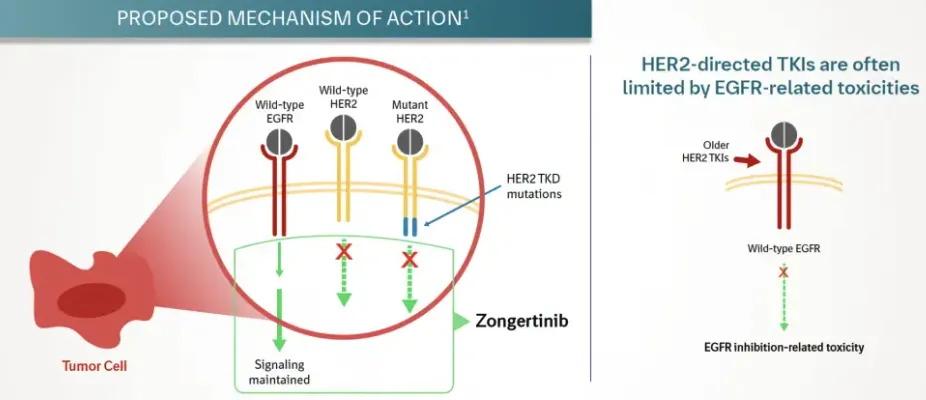
The structure of zongertinib was also designed to improve the drug’s selectivity for HER2 over wild-type EGFR. Wild-type EGFR is present widely in normal tissue, including the skin and the gastrointestinal tract. Reducing unnecessary inhibition of wild-type EGFR is what helps lower some of the EGFR-related skin and gastrointestinal toxicity that limited earlier HER2-directed tyrosine kinase inhibitors.
Included in guidelines in China and abroad
As the evidence has accumulated, zongertinib has been recommended by major guidelines:
- The NCCN non-small cell lung cancer guideline, version 5.2026, lists zongertinib as a first-line targeted treatment option for HER2-mutant advanced non-small cell lung cancer.
- In China, the 2026 CSCO non-small cell lung cancer guideline gives zongertinib a Grade I recommendation for later-line treatment of HER2-mutant advanced non-small cell lung cancer.
From later lines to first line: what the clinical data show
The approval of zongertinib rests mainly on the Beamion LUNG-1 study. This is an open-label, multicentre, multi-cohort phase Ia/Ib clinical study evaluating the efficacy and safety of zongertinib in HER2-mutant advanced tumours.
First-line treatment: about three-quarters of patients had marked tumour shrinkage
Cohort 2 of Beamion LUNG-1 enrolled 74 patients with HER2-mutant advanced or metastatic non-squamous non-small cell lung cancer who had not previously received systemic treatment for advanced disease. They received zongertinib 120 mg once daily. Assessed by blinded independent central review:
- Objective response rate (ORR): 75.7%
- Median duration of response (DoR): 15.2 months
- Median progression-free survival (PFS): 14.4 months
- Among patients who responded, 64% had a response lasting at least 12 months
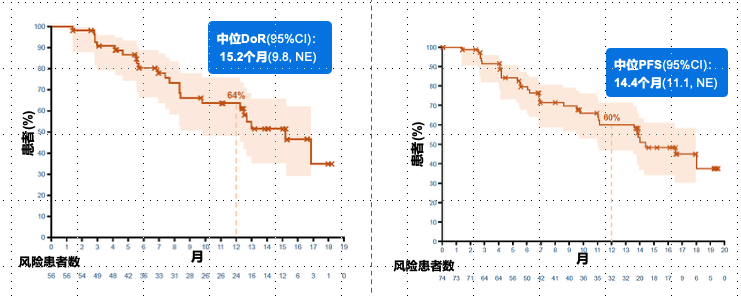
These results indicate that most patients had clear tumour shrinkage on first-line zongertinib, and that in some of them the response was maintained for a long period. One caveat matters. Beamion LUNG-1 is an early, single-arm study, and mature long-term overall survival data are not yet available. How much zongertinib adds over standard first-line treatment still needs to be confirmed by the randomised phase III studies that are now under way.
Previously treated patients: responses carry through
In the previously treated cohort of Beamion LUNG-1, 75 patients with HER2 tyrosine kinase domain-mutant advanced non-small cell lung cancer who had received at least one prior systemic therapy were treated with zongertinib. The clinical data show:
- Objective response rate (ORR): 72.0%
- Median duration of response (DoR): 14.1 months
From the previously treated cohort to the treatment-naive cohort, zongertinib produced consistently high tumour response rates, which is part of the clinical basis for moving it earlier in the treatment sequence.
Brain metastases: objective intracranial responses
Brain metastases are one of the major difficulties in treating HER2-mutant advanced non-small cell lung cancer. In a further exploratory cohort of Beamion LUNG-1, 30 patients with active brain metastases received zongertinib. Judged by the response assessment criteria for brain metastases in neuro-oncology:
- Intracranial ORR was 50% in previously treated patients with stable, asymptomatic brain metastases.
- Intracranial ORR was 47% in treatment-naive or previously treated patients with active brain metastases.
- Intracranial ORR was 59% in patients who had not received brain radiotherapy and who had measurable intracranial lesions.
How well is zongertinib tolerated?
Pooled safety data for 292 patients, as summarised in the Chinese product label, show that the most common adverse reactions are:
- Diarrhoea: 54%
- Rash: 28%
- Hepatotoxicity: 27%
- Fatigue: 25%
- Nausea: 23%
- Musculoskeletal pain: 21%
- Upper respiratory tract infection: 20%
In the first-line cohort, 91% of patients had a treatment-related adverse event, and the rate of grade 3 or above treatment-related adverse events was 19%. The more common treatment-related reactions — diarrhoea, rash, raised transaminases, altered taste, nausea and dry skin — were mostly low grade.
Three areas need particular attention during treatment:
- Hepatotoxicity: recheck regularly according to the clinical situation and the treating physician’s advice.
- Reduced left ventricular function: monitor cardiac function periodically during treatment.
- Interstitial lung disease or inflammation of the lungs: reported in 2.1% of the pooled safety population. New or worsening breathlessness, cough or fever should prompt a timely medical assessment.
Zongertinib must be used under the guidance of a physician experienced in antitumour therapy. The treating team decides whether to continue treatment, pause it, reduce the dose or stop permanently, based on the type and severity of adverse reactions. Patients should never adjust the dose themselves.
Individualised treatment, with continuing follow-up
New Frontier Medical operates Integrated Oncology Centres in Beijing, Shanghai, Guangzhou, Shenzhen and Hong Kong. The centres are built around a full-cycle oncology pathway that runs from screening and diagnosis through treatment, follow-up and rehabilitation to supportive care.
The value of an innovative drug lies not only in refreshed clinical data. It lies in whether professional, standardised and humane care can turn that data into a treatment option patients can actually reach. Zongertinib has already been in clinical use at Shenzhen New Frontier United Family Hospital for some time. With the first-line indication approved, both the group of patients it can help and the point in their treatment journey at which it can be considered have widened.
For a patient with advanced non-small cell lung cancer, whether zongertinib is suitable cannot be judged on the words HER2-positive alone. The treating team needs to distinguish HER2 mutation from HER2 amplification and from HER2 protein overexpression, to establish which region of the gene is affected and which testing method was used, and to weigh the patient’s pathological type, previous treatment, brain metastases, liver function, cardiac function, coexisting conditions and treatment goals.
Monitoring also continues throughout treatment. Tumour response, liver function, cardiac function, respiratory symptoms, diarrhoea and skin reactions all need to be followed, with the management plan adjusted promptly to how well the patient tolerates treatment.
United Family Healthcare builds its oncology service with an international outlook, giving weight to survival benefit, quality of life and the experience of treatment. The group follows advances presented at international oncology congresses including ASCO, ESMO and WCLC, and offers a broad range of antitumour options covering targeted drugs, immunotherapy, antibody-drug conjugates and innovative drugs developed in China. Cancer prevention, treatment and rehabilitation education is a long-term focus, and the group will continue to review and share frontier clinical research and treatment advances across tumour types.
About the authors
Shi Ying is chief pharmacist of New Frontier Medical Group, chief pharmacist of New Frontier Medical in the Greater Bay Area, director of pharmacy at the Hong Kong Integrated Oncology Centre, and director of pharmacy at Shenzhen New Frontier United Family Hospital.
Jia Lin is a chief physician in the departments of oncology at Shenzhen New Frontier United Family Hospital, and holds a doctorate in oncology and a postdoctoral fellowship in tumour immunology.
About the source
Source: the Shenzhen New Frontier United Family Hospital public-education article “From Later Lines to First Line: Zongertinib Covers Treatment-Naive HER2-Mutant Lung Cancer”. Adapted for international readers by MedTourChina.
Important information
This article is intended for disease and drug education only and does not constitute individualised diagnostic or treatment advice for any patient. For indications, dosage, adverse reactions and precautions, always refer to the latest version of the product label approved by the national drug regulatory authority.
References
- Zongertinib tablets product label. Approval date: 26 August 2025; revision date: 19 May 2026.
- Heymach JV, Yamamoto N, Girard N, et al. First-Line Zongertinib in Advanced HER2-Mutant Non-Small-Cell Lung Cancer. N Engl J Med. 2026;394(17):1675-1684. doi: 10.1056/NEJMoa2516969.
- Heymach JV, Ruiter G, Ahn MJ, et al. Zongertinib in Previously Treated HER2-Mutant Non-Small-Cell Lung Cancer. N Engl J Med. 2025;392:2321-2333. doi: 10.1056/NEJMoa2503704.
- Wilding B, Woelflingseder L, Baum A, et al. Zongertinib, an Irreversible HER2 TKI, Spares EGFR Signaling and Improves Therapeutic Response in Preclinical Models and Patients with HER2-Driven Cancers. Cancer Discov. 2025;15(1):119-138. doi: 10.1158/2159-8290.CD-24-0306.
- U.S. Food and Drug Administration. FDA grants accelerated approval to zongertinib for non-squamous NSCLC with HER2 TKD activating mutations. 8 August 2025.
- U.S. Food and Drug Administration. FDA Grants Second Approval under the National Priority Voucher Pilot Program. 26 February 2026.
- Boehringer Ingelheim. First-line indication of Hernexeos approved in China, the first first-line targeted therapy for HER2-mutant lung cancer in the country. 21 May 2026.
Facing a HER2-mutant lung cancer diagnosis in China? Our international team can help you arrange a molecular testing review and reach the right oncology specialists. We reply within 24 hours.
Speak with our international team · See the Shenzhen campuses and clinics